• Because today, May 18, is Adrien’s birthday, I decided to bake one of his favorite breakfast treats: scones.

    I really like this recipe from King Arthur Baking because it is a simple base from which to experiment. This morning, I added cinnamon bits and substituted maple syrup for the flavoring, but really, whatever the recipe accommodates any whims or cravings. By setting up the dry ingredients the night before, I had hot scones ready for breakfast in 30 minutes.

    Special birthdays definitely should start with breakfast.

    King Arthur Baking Simple Scones

    Ingredients

    Dough

    • 2 3/4 cups (326g) King Arthur Unbleached All-Purpose Flour or King Arthur Pastry Flour Blend
    • 1/3 cup (67g) granulated sugar
    • 3/4 teaspoon salt
    • 1 tablespoon (12g) baking powder
    • 8 tablespoons (113g) unsalted butter, cold
    • 1 cup to 2 cups (113g to 227g) chopped dried fruit, chocolate or other flavored chips, nuts, or a combination
    • 2 large eggs
    • 2 teaspoons vanilla extract, or flavoring of your choice
    • 3/4 cup (170g) half-and-half or milk

    Topping (optional)

    Method

    1. Preheat oven to 375°F. (Shaping options on the original recipe; however I lined a baking sheet with parchment, and pat the dough into a circle which is then segmented into eighths)
    2. In a large mixing bowl, whisk together all the dry ingredients.
    3. Cut in the butter just until the mixture is unevenly crumbly; it’s OK for some larger chunks of butter to remain unincorporated.
    4. Stir in the fruit, chips, and/or nuts.
    5. In a separate mixing bowl, whisk together the eggs, vanilla or other flavor, and half-and-half or milk. Add the liquid ingredients to the dry ingredients and stir until all is moistened and holds together.
    6. Using a muffin scoop or a 1/3-cup measure, generously filled, fill your scone pan or baking cups. Or plop the dough in mounds onto the baking sheet. Brush with a bit of milk and top with coarse sparkling sugar. (see step one for my adaptation)
    7. Bake the scones 25 minutes to 30 minutes until lightly browned. Remove them from the oven and let them sit for 4 to 5 minutes to firm before removing them from the pan.
    8. Serve scones warm with butter and/or jam.
  • We hosted family for a casual lunch on Mothers’ Day this year. When picking out what to cook for our family get-togethers, there’s a lot to think about when considering the guests range in age from 3 to 98.

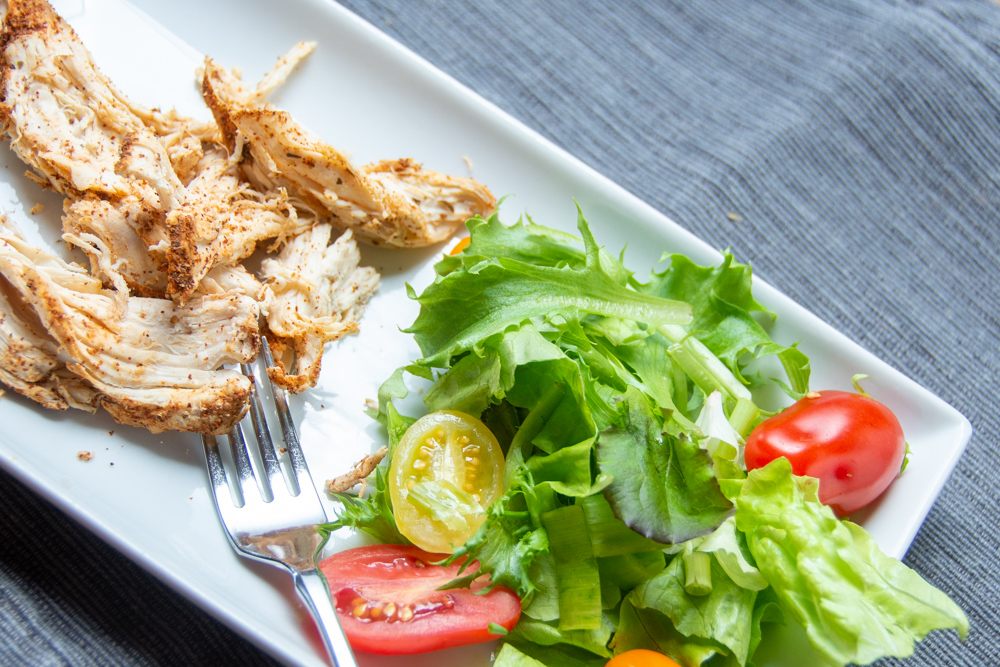
    This simple and versatile recipe comes from Karie Houghton via Taste of Home website. It was simple to prep and, being a slow-cooker recipe, even easier to cook. We served it with a green lettuce and tomato salad (scallions, avocado and dressing on the side) and with sandwich buns for those who preferred sandwiches over salad.

    Definitely a keeper for family gatherings. Use the recipe’s link for nutrition information.

    Slow Cooker Chicken Taco Salad

    Karie Houghton (Lynnwood, WA) on Taste of Home

    Ingredients

    • 3 tsp chili powder
    • 1 tsp each ground cumin, seasoned salt and pepper (I used Kosher salt)
    • 1/2 tsp each white pepper, ground chipotle pepper and paprika
    • 1/4 tsp dried oregano
    • 1/4 tsp crushed red pepper flakes
    • 1-1/2 pounds boneless skinless chicken breasts
    • 1 C chicken broth
    • 9 C torn romaine (I used a mix of green leaf and baby romaine)
    • Optional toppings: Sliced avocado, shredded cheddar cheese, chopped tomato or halved cherry tomatoes, sliced green onions and salad dressing of your choice

    Method

    1. Mix seasonings
    2. Rub over chicken. Place in a 3-qt. slow cooker.
    3. Add broth. Cook, covered, on low until chicken is tender, 3-4 hours.
    4. Remove chicken; cool slightly. (This was done the day before serving, refrigerated, and then warmed slightly – keep a bit of the liquid from cooking so the chicken stays moist)
    5. Shred with 2 forks. Serve over romaine; top as desired. (I also served on sandwich buns with the accompaniments)
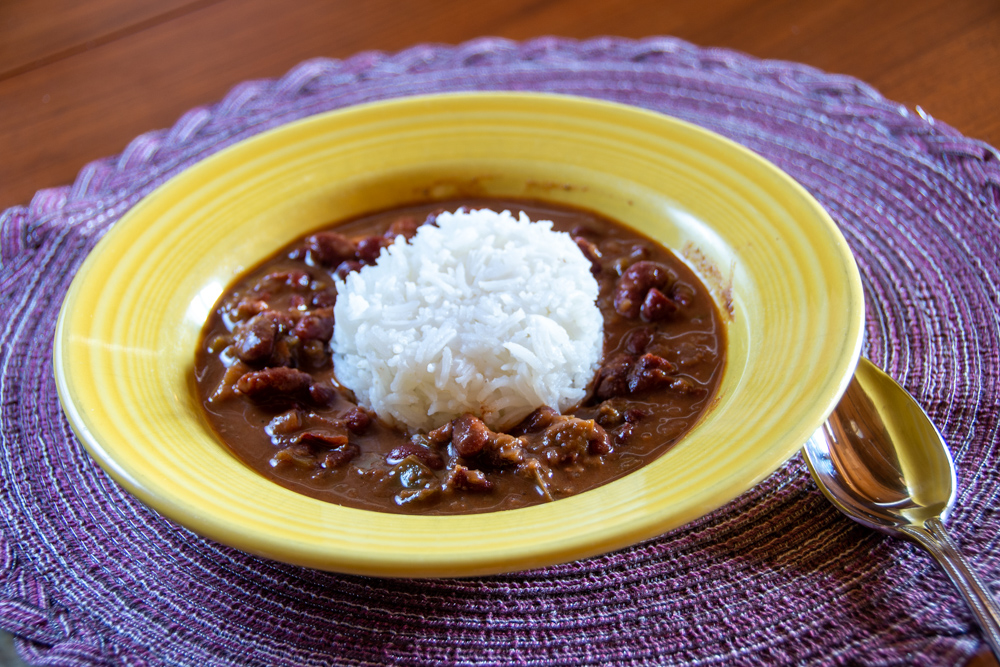
  • Sometimes I feel like I don’t make enough use of my Instant Pot. However, whenever we make a bean-based dish calling for dried beans, I absolutely know that going back to the “old ways” of prepping dried beans has been made infinitely more easy since Instant Pots and pressure cooking came back into vogue.

    This meal has some prep to it, as well as a somewhat long list of ingredients. I dislike dried garlic powder and dried onion powder so a) I never have them in the pantry and b) I never use them. However, if you feel inclined, I’ve included the original recipe’s ingredient list which does list them. Cook the rice about 10 minutes before the pressure-cooker cycle is completed and it should be just about perfect as you are releasing the Instant Pot’s pressure manually (cooking time about 20-25 min).

    A Louisiana-style hot sauce is a key to the “Monday Red Beans” dish reminiscent of New Orleans. Luckily for us, we have a local purveyor, Craic Sauce, whose Mill City Red is the perfect addition to this dish. Check them out if you live here in New England, or order from their web site here.

    Vegan Pressure Cooker Red Beans and Rice

    Sarah DiGregorio in the New York Times

    Ingredients

    • ¼ cup vegetable oil
    • 1 large yellow onion, finely chopped
    •  Kosher salt and black pepper
    • 3 celery stalks, finely chopped
    • 1 green bell pepper, finely chopped
    • 10 garlic cloves, finely chopped
    • 1 heaping tablespoon white or yellow miso paste
    • 2 teaspoons smoked paprika
    • 1 teaspoon sweet paprika
    • 1 teaspoon onion powder (I did not use this)
    • 1 teaspoon garlic powder (I did not use this)
    • ½ to 1 teaspoon ground cayenne, plus more to taste
    • ½ teaspoon ground sage (optional)
    • 1 pound dried red kidney beans (no need to soak)
    • 3 dried bay leaves
    • 3 fresh thyme sprigs or 1 teaspoon dried thyme
    • 1 teaspoon soy sauce
    •  Cooked rice, for serving
    •  Sliced scallions, for serving
    •  Louisiana-style hot sauce, for serving

    Method

    1. Turn on the sauté setting of a 6- to 8-quart electric pressure cooker and heat the oil.
    2. Add the onion, season with salt, and cook, stirring occasionally, until limp and translucent, 6 to 8 minutes.
    3. Add the celery and bell pepper, and cook, stirring occasionally, until softened, 5 to 8 minutes.
    4. Add the chopped garlic, miso paste, smoked paprika, sweet paprika, onion powder, garlic powder, cayenne and sage (if using). Grind in a generous amount of black pepper and add 3/4 teaspoon salt. Stir well to combine all the ingredients, then turn off the sauté setting.
    5. Add the beans, bay leaves, thyme and 5 1/2 cups water. Scrape the bottom of the pot to loosen any browned bits. Cook on high pressure until the beans are creamy, 50 minutes to 1 hour.
    6. Turn off the pressure cooker and allow the pressure to reduce naturally for 10 minutes, then release the remaining pressure manually and open the lid.
    7. Add the soy sauce, and season to taste with salt and cayenne. Using a fork, mash some of the beans against the side of the pressure cooker to make the mixture creamy. It will continue to thicken as it sits, or you can turn on the sauté setting and let the mixture bubble for a few minutes to thicken.
    8. Discard the bay leaves and thyme sprigs. Top the beans with hot cooked rice and scallions; serve with hot sauce.
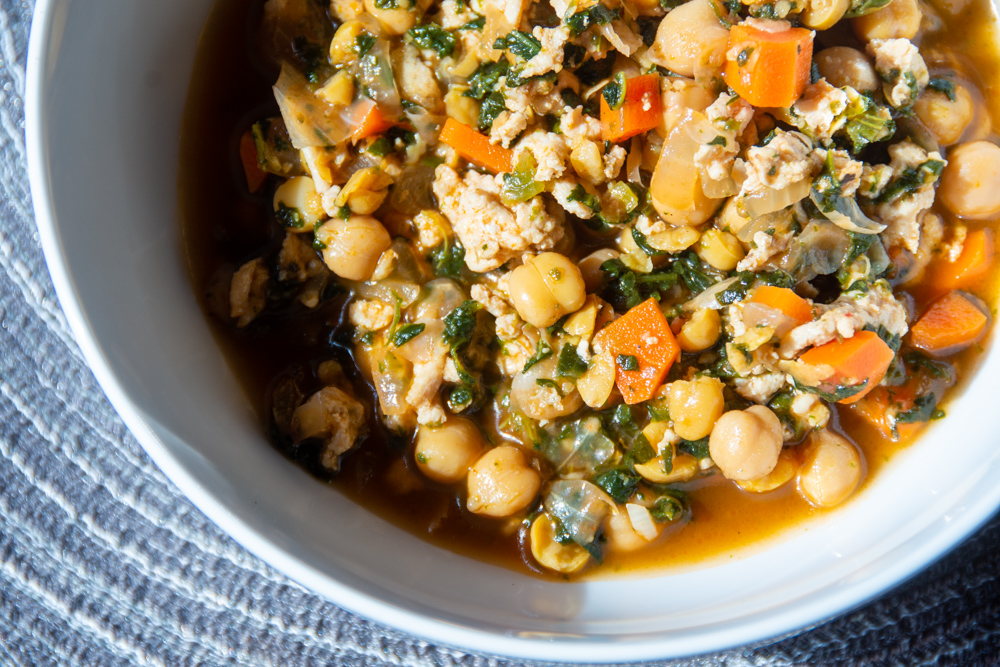
  • This soup was very satisfying – not vegetarian, but could easily adapted to be so. The combination of mashed and whole chickpeas made for an interesting texture. I personally would substitute something less salty for the chicken broth (wine?) and I would never use garlic powder.

    The portion sizes must be huge! I made a half-recipe and still had about 4 servings.

    Hearty Chickpea and Spinach Stew

    Recipe from Patsy Jamieson, Diabetic Living (Spring 2019). Downloaded from Eating Well Magazine

    Ingredients (Full Recipe as published)

    • 2 (15 ounce) cans low-sodium chickpeas, rinsed, divided 
    • 1 tablespoon olive oil 
    • 12 ounces 93%-lean ground turkey 
    • ½ teaspoon dried oregano 
    • ½ teaspoon fennel seeds, crushed 
    • ½ teaspoon crushed red pepper 
    • 1 medium onion, chopped (1 cup) 
    • 2 medium carrots, diced (3/4 cup) 
    • 4 cloves garlic, minced, or 1/2 teaspoon garlic powder 
    • 3 tablespoons tomato paste 
    • 1 (32 ounce) carton low-sodium chicken broth (4 cups) 
    • ¼ teaspoon ground pepper 
    • ⅛ teaspoon salt 
    • 3 cups IQF (individually quick-frozen) spinach (8 oz.) 
    • ¼ cup grated Parmesan cheese (Optional)

    Method

    1. Mash 1 can chickpeas with a potato masher or fork. Set aside.
    2. Heat oil in a large pot over medium-high heat. Add turkey, oregano, fennel seeds, and crushed red pepper; cook, crumbling with a wooden spoon, until the turkey is no longer pink, 2 to 3 minutes. Add onion, carrots, and garlic (or garlic powder); cook, stirring often, until softened and fragrant, 3 to 4 minutes. Add tomato paste; cook, stirring, for 30 seconds.
    3. Add broth, the mashed and whole chickpeas, pepper, and salt to the pot. Cover and bring to a simmer. Reduce heat to medium and cook, covered, at a brisk simmer until the vegetables are tender and the flavors have blended, about 10 minutes.
    4. Add spinach* and increase heat to medium-high, Cook, stirring, until the spinach is heated through, 1 to 2 minutes. Ladle the soup into bowls. Garnish each serving with 1 Tbsp. Parmesan, if desired.
    • * if using frozen spinach, go ahead and add to the mix in step 3.
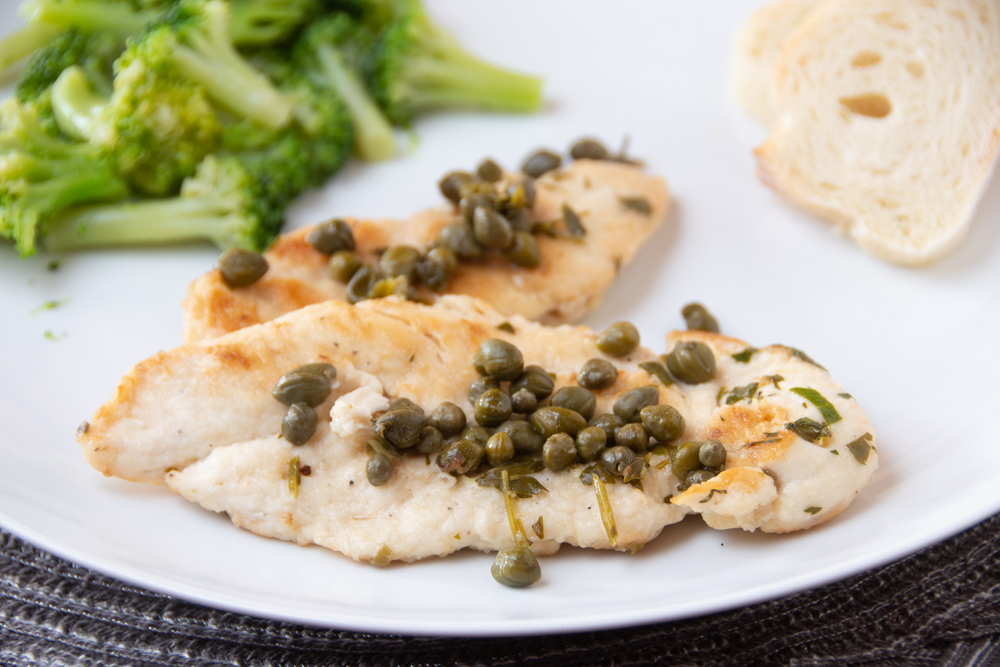
  • We don’t consume much meat or poultry any more, but when I do, I live by the mantra “a little goes a long way”. So this recipe for Chicken Piccata from Whole Foods Market was light on the chicken and the serving sizes were much smaller.

    The chicken meat was pounded with a rolling pin between 2 pieces of wax paper until they were about 1/4 thick. This allows for quick a sauté and, in my opinion, makes smaller serving sizes completely reasonable. I also threw in an equivalent amount of white wine in place of the chicken broth which I thought didn’t harm the taste at all.

    Whole Foods Market Chicken Piccata

    Ingredients

    • 4 skinless, boneless chicken cutlets (about 1 1/4 lbs)
    • 1 lemon, zested and juiced
    • 1/2 cup all-purpose flour
    • 1/2 tsp fine sea salt
    • 1/2 tsp ground black pepper
    • 2 TBSP olive oil
    • 1/3 cup drained capers
    • 1/2 cup dry white wine
    • 3/4 cup low-sodium chicken broth
    • 2 TBSP chopped fresh parsley

    Method

    1. Place chicken cutlets between 2 sheets (parchment or waxed paper preferred over plastic wrap). With a mallet or rolling pin, gently pound cutlets to an even 1/4-inch thickness.
    2. In a shallow bowl or pie plate, combine flour, lemon zest, salt and pepper. Dip chicken in flour, coat all sides and shake off excess.
    3. Preheat a large skillet over medium-high heat.
    4. Carefully place chicken in hot oil and cook until browned and cooked through – about 3 minutes per side. Transfer chicken to a clean place and cover to keep warm.
    5. Add capers to pan and cook for 1 minute until browned on edges and slightly plumped. Add wine and chicken broth and bring to a brisk simmer, stirring with a wooden spoon to scrape up browned bits from the bottom of the pan.
    6. Cook until liquid is reduced by half, 3 to 4 minutes.
    7. Remove pan from heat and stir in parley and 2 TBSP of the lemon juice. Taste and adjust seasonings with salt, pepper and lemon juice.
    8. Divide chicken among plates , top with capers and drizzle with sauce.
  • One of the rewards of reading David Lebovitz’s Sweet Life in Paris was discovering some of his favorite recipes interspersed among entertaining story-telling of adapting to Paris and French culture. This recipe is one of my favorites – you can find David’s original blog post here – definitely a must-read.

    For this, my second-ever batch of madeleines, I followed the recipe exactly. The key to success – in my humble amateur-baker opinion – is to pop the madeleine tray into the freezer while the oven heats up. Keeping the batter and the madeleine mold super cold resulted in perfectly shaped madeleines. My other cautionary advice is know your oven. Mine is a little quirky, i.e., it runs hot, which I discovered as I turned the first batch of 12 out of the pan at 8 minutes. The second batch which meant I needed a good cool-down of pan and batter after the first batch of 12 – came out more madeleine-like at 7 minutes. So noted.

    I’ve recently begun using volume measurements for baking and followed the amounts given for grams in the recipe.This recipe yields 24 madeleine, so be sure to either have 2 pans or be prepared to do a little juggling in between batches.

    Also note David’s suggestion regarding storing unless you’ve got plans for all 24 pretty soon after baking.

    If you’re a fan of Proust, these lovely French treats will help pass the time spent reading the longest novel known to humankind. But if you just want to enjoy a treat that can transport you back to Paris – that works too.

    David Lebovitz’s Lemon-Glazed Madeleine

    Ingredients

    • 3 large eggs, at room temperature
    • 2/3 cup (130g) granulated sugar
    • rounded 1/8 teaspoon salt
    • 1 1/4 cup (175g) flour
    • 1 teaspoon baking powder, (optional)
    • zest of one small lemon
    • 9 tablespoons (120g) unsalted butter, melted and cooled to room temperature, plus additional melted butter for preparing the molds
    • 3/4 cup (150g) powdered sugar
    • 1 tablespoon freshly-squeezed lemon juice
    • 2 tablespoons water

    Method

    1. Brush the indentations of a madeleine mold with melted butter. (I melted the butter as I was assembling the ingredients for baking – doing so meant the butter was cooled down when needed) Dust with flour, tap off any excess, and place in the fridge or freezer. (I used the freezer)
    2. In the bowl of a standing electric mixer, whip the eggs, granulated sugar, and salt for 5 minutes until frothy and thickened. (no shortcutting – set a timer)
    3. Spoon the flour and baking powder, if using, into a sifter or mesh strainer and use a spatula to fold in the flour as you sift it over the batter.
    4. Add the lemon zest to the cooled butter, then dribble the butter into the batter, a few spoonfuls at a time, while simultaneously folding to incorporate the butter. Fold just until all the butter is incorporated.
    5. Cover the bowl and refrigerate for at least 1 hour. (Batter can be chilled for up to 12 hours.)
    6. To bake the madeleines, preheat the oven to 425 degrees.
    7. Plop enough batter in the center of each indentation with enough batter (remember, this makes 24, which may help with eyeballing the amount of batter) which you think will fill it by 3/4’s (you’ll have to eyeball it, but it’s not brain-surgery so don’t worry if you’re not exact.) Do not spread it.
    8. Bake for 8-9 minutes or until the cakes just feel set. While the cakes are baking, make a glaze in a small mixing bowl by stirring together the powdered sugar, lemon juice, and water until smooth.
    9. Remove from the oven and tilt the madeleines out onto a cooling rack. The moment they’re cool enough to handle, dip each cake in the glaze, turning them over to make sure both sides are coated and scrape off any excess with a dull knife. After dipping, rest each one back on the cooking rack, scalloped side up, until the cakes are cool and the glaze has firmed up.
  • This was a delightful soup – hot or cold. Night One we ate it just as it finished cooking with a dollop of Greek yogurt, lime, and some basil. The next day, I took Dorie Greenspan at her word that the soup was good hot or cold and ate leftovers straight from the fridge. Both ways were delicious!

    A combination of leeks, shallots, garlic, zucchini, asparagus, and basil, the soup needed no other seasoning than a bit of salt and pepper.

    The recipe comes from Dorie Greenspan’s Everyday Dorie, which has become one of my regular go-to’s for weekly recipe ideas (purchasing details are here).

  • Recently, I finished reading David Lebovitz’s book, The Sweet Life in Paris, which tells about his move to Paris and coming to terms with the cultural differences between his newly adopted home in Paris and San Francisco where he lived and worked. More than just a relocation, moving to Paris, or any other location really, involves some cultural shifts. David’s retelling of adapting to new ways not only triggered memories of our short-term travel to Paris, but also serves as a reminder that personal growth can sometimes be uncomfortable. And funny.

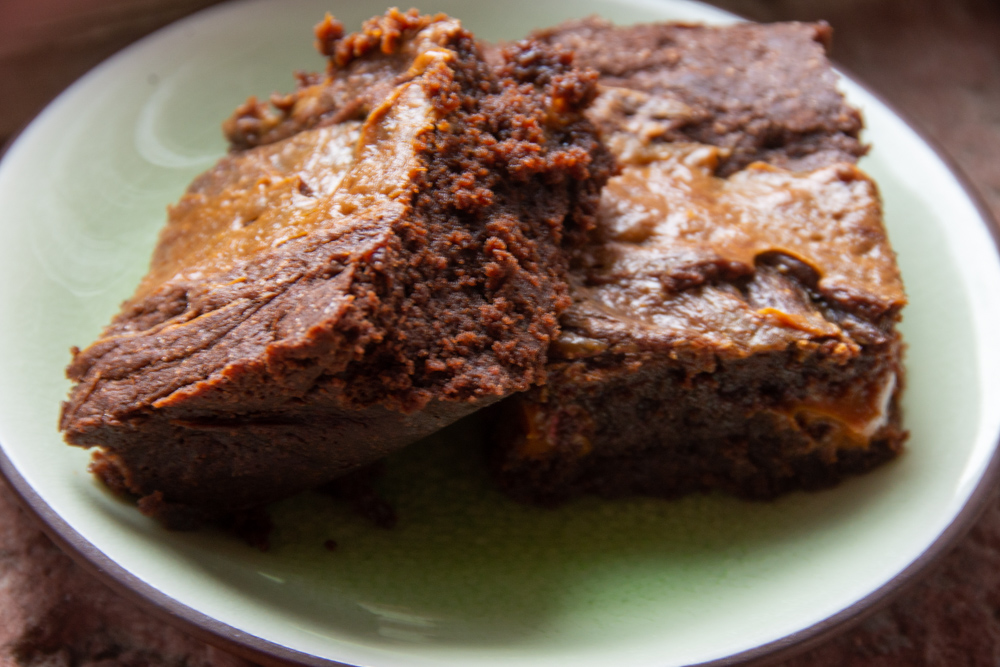
    David included some outstanding favorite recipes in his book. This one, Dulce de Leche Brownies, was one of the last shared and it was, in my opinion, a winning way to close out this narrative.

    I’ve left the weight measurements in the recipe as those produce a more consistent result.

    Dulce de Leche Brownies

    David Lebovitz

    Ingredients

    • 8 tablespoons (115g) salted or unsalted butter, cut into pieces
    • 6 ounces (170g) bittersweet or semisweet chocolate, finely chopped
    • 1/4 cup (25g) unsweetened cocoa powder, preferably Dutch-process
    • 3 large eggs, at room temperature
    • 1 cup (200g) sugar
    • 1 teaspoon vanilla extract
    • 1 cup (140g) flour
    • optional: 1 cup (100g) toasted pecans or walnuts, coarsely chopped
    • 1 cup (260g) Dulce de leche (David Lebovitz share’s his own recipe (linked), but I wimped out here and used a commercial version that I had in the pantry)

    Method

    1. Preheat the oven to 350ºF degrees (175 C.)
    2. Line an 8-inch (20 cm) square pan with a long sheet of aluminum foil that covers the bottom and reaches up the sides. If it doesn’t reach all the way up and over all four sides, cross another sheet of foil over it, making a large cross with edges that overhang the sides. Grease the bottom and sides of the foil with some softened butter or non-stick spray.
    3. Melt the butter in a medium saucepan. Add the chocolate and stir constantly over very low heat until the chocolate is melted. Remove from heat and whisk in the cocoa powder until smooth. Add in the eggs one at a time, then stir in the sugar, vanilla, then the flour. Mix in the nuts, if using.
    4. Scrape half of the batter into the prepared pan. Drop one-third of the dulce de leche by scant tablespoons evenly spaced over the brownie batter. Either drag a butter knife through the dulce de leche mounds to swirl them very slightly, being careful not to overdo it, or leave the mounds as they are. Spread the remaining brownie batter over, then drop spoonfuls of the remaining dulce de Leche in dollops over the top of the brownie batter. Use a knife to swirl the dulce de Leche slightly.
    5. Bake until the center feels just-slightly firm, but still jiggly, about 30 minutes, but check them at the 25-minute mark as different chocolates behave differently and with these brownies, as with most brownies, you want to catch them before they become overbaked. Remove from the oven and cool completely. Once cool, lift the brownies out of the pan by grabbing the edges of the foil to remove them from the pan. 
  • I was fortunate to stay at Kripalu Center for Yoga and Health a few years ago. Along with the inspirational yoga, Kripalu has a wonderful and well-earned reputation for deliciously healthy and healing foods. This delicious soup from Chef Jeremy Rock Smith is bright with lemon and dill and not at all heavy. Highly recommended: Chef Smith’s Kripalu Kitchen cookbook which is filled with healthy recipes that will satisfy hunger as well as your soul.

    Lemony Carrot Soup with Fennel Relish

    Chef Jeremy Rock Smith, Kripalu Executive Chef

    Ingredients

    • 3 cups finely chopped carrots (I used the food processor to get these chopped finely)
    • 1/2 cup minced onion
    • 2 TBSP finely chopped fennel
    • 1 1/2 TBSP EV Olive Oil
    • 1/4 tsp group fennel seed (I used a mortar & pestle to pulverize the whole seeds)
    • 4 cups vegetable stock
    • 3 TBSP fresh lemon juice
    • 2 tsp fresh dill, chopped
    • 1/2 tsp sea salt
    • 1/4 tsp freshly ground black pepper

    Fennel Relish Ingredients

    • 1 cup shaved fennel (from 1 small bulb)
    • 2 tsp fresh lemon juice
    • 1/2 tsp grated lemon zest
    • 1 TBSP olive oil
    • 1/4 tsp sea salt
    • Pinch freshly ground black pepper

    Method

    I prepared the relish first so it had time to macerate:

    Fennel Relish: Combine everything is a small bowl. Let macerate at room temperature for about 20 minutes to blend the flavors.

    For the soup:

    1. Heat a medium soup pot over low heat. Put in the carrots, onions, fennel and oil, shaking the pot to coat the vegetables. Cover and sweat gently until the carrots are almost tender (8-10 minutes).
    2. Uncover and stir in the ground fennel seed. Raise the heat to medium and cook until the spice is fragrant (2-3 minutes). Add the stock and bring to a boil over high heat, then reduce the heat to medium low and simmer gently until the flavors blend and the carrots are very tender (8-10 minutes).
    3. Puree the soup until smooth with an immersion blend (or use a regular blender – I alway tend toward the immersion).
    4. If using the regular blender take care to avoid a blowout by slightly cooling the soup and leaving the center lid off the top of the blender. Return soup to the pot.
    5. Stir in the lemon juice, dill, salt and pepper. Serve hot with the relish as desired.
  • It’s Monday and time for the #Moosewood2022 challenge! This recipe comes right from the original Moosewood Cookbook, one we purchased in 1978.

    This was surprisingly filling, and unsurprisingly, delicious. I’ll admit to taking a shortcut with the butternut squash though as our local grocer did not have any butternut squash this week. I used a bag of quick-frozen squash, which is a timesaver of course, but less tasty than if I had started by roasting my own vegetable. Also, frozen squash, even when defrosted slowly, has a lot of water that needs to be poured off. Next time, I’ll hold out for the real thing.

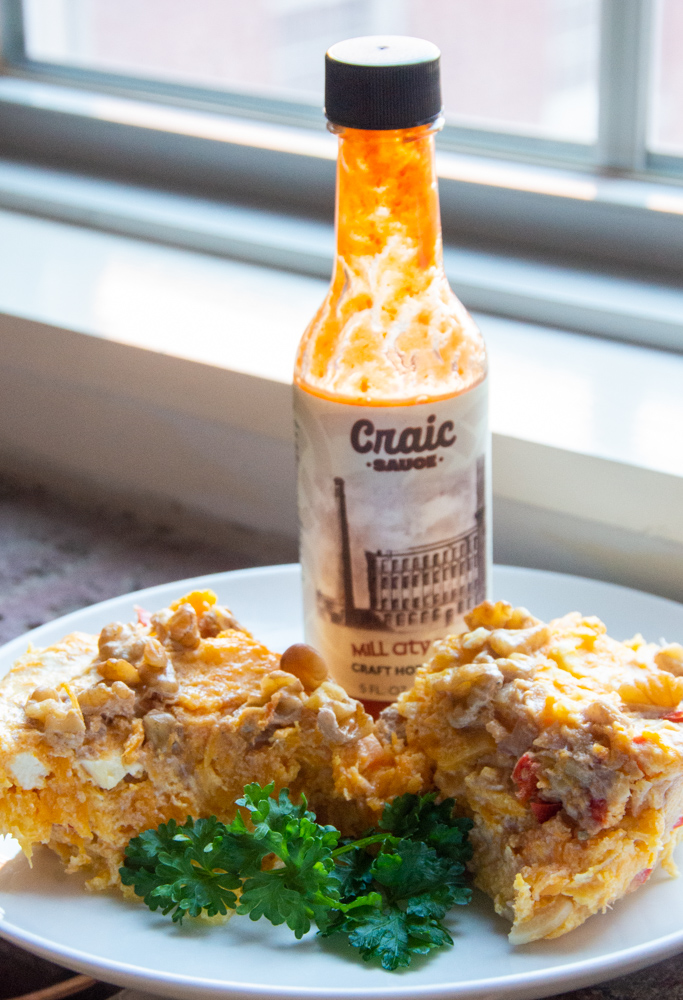
    I served the squash with Mill City Red, a local hot sauce created by Brian Ruhlman of Craic Sauce. If you’re not fortunate enough to live locally in Lowell, Massachusetts, you can find this sauce online here.

    Arabian Squash-Cheese Casserole

    Mollie Katzen, Moosewood Cookbook

    Ingredients

    • 2 medium-large butternut or acorn squash
    • 1 heaping c chopped onion
    • 2-3 cloves crushed garlic
    • 1 heaping c mixed green and red peppers, chopped
    • 3 TBSP butter for sauté (I used coconut oil)
    • 1 tsp salt
    • 2 beaten eggs
    • 1 c buttermilk or yogurt (I used 0% yogurt)
    • 1/2 c crumbled feta cheese
    • black & red pepper to taste
    • 1/4 c sunflower seeds or chopped nuts for the top) (I used walnuts)

    Method

    1. Cut the squash down the middle lengthwise. Scoop out the seeds, and place it face-down on an oiled tray. Bake it at 375 degrees about 35 minutes, or until soft. Cool until handle-able; scoop out and mash.
    2. Sauté the onion and garlic, lightly salted, in butter. When the onion is translucent, add the chopped peppers. Sauté until the peppers are just under-done.
    3. Beat eggs with buttermilk or yogurt. Crumble in the feta cheese. Combine everything and mix well. Add salt, black pepper and red pepper or hot sauce (I held the hot sauce until serving).
    4. Spread into a butter casserole or baking pan. Top with seeds or nuts.
    5. Bake at 375 degrees F – covered for 25 minutes, then uncovered for 10 minutes.